
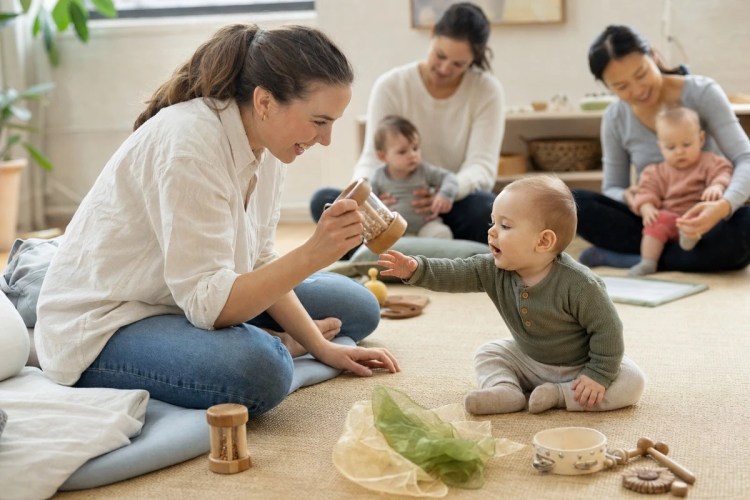
Leaving the house used to be simple. Now it takes a packed diaper bag and a bit of nerve.
Baby classes give you a reason to do it anyway. You get out, you meet other parents, and the two of you try something new together. But picking that first class brings a pile of questions. Is my baby old enough? What if they cry the whole time? Which type should we try? And is any of this actually worth it?
Baby classes aren’t about perfect participation or hitting milestones early. A good one is just a relaxed room where babies get to explore and grown-ups get to connect with them, and with each other.
When Can Babies Start Classes?
There’s no single right age. Some programs take newborns. Others start at three months, six months, or a year. Every class should list its own age range and what’s expected of you.
For very young babies, gentle works best: music, storytime, infant massage, or caregiver-and-baby movement. Once babies have head control and start paying attention to the world around them, floor play, instruments, textures, and movement classes get a lot more fun.
Your own recovery counts too. If a class includes postpartum exercise or yoga, think about the kind of delivery you had and whether there were complications. The American College of Obstetricians and Gynecologists says to return to exercise gradually and to check with your health care provider when needed, especially after a cesarean or a complicated birth.
If your baby was born early or has medical or developmental needs, ask your pediatrician whether you should take extra precautions.
And don’t rush. Starting at two months, six months, or later doesn’t mean you missed a window. The right time is whenever the two of you can actually enjoy it.
A Few Things I Learned the Hard Way
Before we get into class types, here’s what I picked up going to these with my own child.
- Don’t compare your baby to the others. It’s not a competition. Every kid moves at their own speed. If your baby ignores the instructor while the baby next to you copies every move, that means nothing.
- Keep your expectations small. You’re not building an Olympian in eight weeks. You’re giving your baby new ways to move and new things to look at. That’s the whole goal.
- The class is for you too. It’s easy to think the baby should be the point. But parent-and-me classes do a lot for the adult in the room. New parents get lonely. Really lonely. In a class you meet people who are living the same week you are. Your partner listens. Your mother sympathizes. The person next to you with the six-month-old actually knows. You can talk about the hard parts and swap tips that hold up in real life.
- Stop hunting for the “perfect” class. It doesn’t exist. Try a couple and keep the one that fits. Reviews help, but they can’t tell you how your baby will react. Kids are different.
- The first session might be a disaster. Go back anyway. Your baby may scream from start to finish. That doesn’t tell you much. Maybe it was a rough day. Maybe the room was loud and strange. Give it another shot before you bail and sign up somewhere else. Some babies just need a few weeks to warm up.
- Pick something close to home. A long drive turns a good class into a chore. A decent class down the road beats a great one across the county, every single time.
Which Kind of Class Should You Try?
Depends on your baby’s age, personality, and what they’re into. And on what you want out of it.
Music Classes
Singing, bouncing, shakers and bells, a bit of movement. Your baby doesn’t have to join in to get something out of it. Hearing voices, watching other people, feeling you move to a beat: that’s the class.
The CDC encourages parents to talk, read, sing, and play music with their babies as part of everyday life. A class hands you new songs and games to use at home.
Movement and Baby Gym Classes
Tummy time, reaching, rolling, crawling, and soft play equipment sized for babies. Look for a program that lets babies go at their own pace instead of pushing everyone through the same drill.
These are great for older babies who want to move.
Sensory and Art Classes
New sounds, colors, textures, and safe materials to grab. Expect a mess. Edible paint, water, and squishy things go everywhere.
Check that the materials suit your baby’s age, especially during the months when everything ends up in their mouth.
Storytime and Early Literacy
Picture books, plus songs and puppets and a bit of wiggling. Lots of public libraries run free baby sessions, which makes them the easiest first try. No fee, no commitment.
It’s fine if your baby stares at the ceiling instead of the book. At this age, hearing language and sharing your attention is the point.
Baby Yoga and Caregiver Fitness
Gentle movement for the baby mixed with stretching or a workout for you. Ask whether the session is built for the baby, the adult, or both. The format and how hard you’ll work vary a lot.
Parent-and-Baby Water Classes
Water classes help babies get comfortable in a pool and give families a chance to build safer habits around water. But for babies under one, treat it as parent-child water play. It doesn’t mean your baby can swim, and it doesn’t protect them from drowning.
The American Academy of Pediatrics says there’s no evidence that infant swim programs lower drowning risk for babies under one. It considers parent-child water play acceptable as long as an adult is watching closely the entire time. For many kids, formal swim lessons can start around the first birthday, depending on readiness.
What to Ask Before You Pay
A nice website and a convenient time slot tell you nothing about what the room feels like. Before you buy a full session, ask:
- Is the class built for my baby’s exact age?
- How many families are in each session?
- What’s the instructor’s experience with infants?
- Can we try a single drop-in class first?
- Are feeding, diaper changes, and breaks okay mid-class?
- How are the shared toys, mats, and equipment cleaned?
- What happens if my baby is sick or we miss a week?
- Is there stroller access and easy parking?
- Can a grandparent or sitter come instead of me?
- Are siblings allowed?
- How loud does the room get?
On Long Island, drive time deserves its own line on that list. A wonderful class is hard to love when getting there means fighting traffic during your baby’s nap. Something nearby that slots into your week usually wins.
What the First Class Actually Looks Like
Your baby might beam at everyone in the room. They might also cry, fall asleep, demand a feed, or spend the whole session watching a ceiling fan.
All normal.
A good class leaves room for feeding, soothing, diaper changes, and the occasional walk in the hallway. An experienced instructor knows babies don’t follow lesson plans. Step outside when you need to. Sit one out. Nobody’s keeping score.
Repetition is normal too. The songs and activities stay similar week to week because familiarity helps babies relax. The baby who watched quietly for three weeks often starts joining in on week four.
Give it more than one visit before you decide. And if the room stays chaotic and badly run, quit. That’s a fine call to make.
What to Pack
Depends on the activity, but for a first class:
- Diapers and wipes
- A change of clothes for the baby
- A spare shirt for you
- A bottle or whatever you normally feed with
- A burp cloth or light blanket
- One small familiar toy
- Water for you
- Non-slip socks, if the class requires them
- A wet bag and swim gear for water classes
Don’t pack for every possible disaster. Most classes are short, and hauling a giant bag makes getting in and out harder than it needs to be.
Finding Classes Near You
Once you know what kind of class you want, compare a few before signing up for the first one you find. Look at age range, location, schedule, cost, and whether they offer a trial.
Families can browse baby and mommy-and-me classes across Long Island to find music, movement, gymnastics, art, and storytime near them.
Libraries, community centers, museums, and parks and rec departments are worth a look too, especially if you want something free or cheap before committing to a full session.
The Class Has to Work for Both of You
Nobody’s grading your parenting on class attendance. A baby class is just one way to spend an hour together and make the early months feel less isolating.
Pick the class that fits the baby you actually have and the schedule you actually keep. Show up with low expectations, give it a few weeks, and remember that crying, feeding, blowouts, and last-minute changes of plan come with the territory.
The best first class isn’t the one where your baby nails every activity. It’s the one you both want to go back to.
Leave a Reply